
Isolated plastic surgeries often look "fake" because the face does not age one feature at a time. The brow, midface, jawline, and neck descend as a single, connected system. When I tighten a single area while its neighbors continue to sag, the result is a visual mismatch that people notice, even when they cannot explain why.
I have devoted more than 20 years exclusively to facial rejuvenation. Over the course of my career, I have performed more than 7,000 facial rejuvenation procedures. I am also the author and co-editor of the surgical textbook Rejuvenation of the Aging Face, which has been translated into multiple languages.
Everything I share here comes from my own experience. Earlier in my career, I performed neck lifts, brow lifts, midface lifts, eyelid surgery, and lip lifts as standalone procedures, then watched how those results looked and held up over time. In this blog, I explain how the face ages as a unit, where isolated procedures fall short, and how my Vertical Restore® approach treats the face as a whole.
The Three Ways the Face Ages
The face ages through three separate but overlapping processes, and all three happen at once. Understanding these changes is the first step I take with every patient when planning facial plastic surgery. The three processes include:
- Skin aging: Skin becomes thinner and crepey, develops lines and wrinkles, and loses its even tone.
- Volume loss: The temples, upper and lower eyelids, cheeks, and lips gradually deflate.
- Deep-level sagging: The lateral brow, midface, jawline, and neck descend over time.
Research supports this layered view of aging. A review published in Plastic and Reconstructive Surgery Global Open explains that changes in the face's distinct fat compartments contribute to the aging face's shape, alongside changes in its supporting ligaments.
Taking care of skin quality requires daily attention, which is why I created the KaramMD® Trifecta, a three-step skincare system. Additionally, addressing volume loss is equally important. For the past 20 years, I have incorporated fat transfer into every surgical rejuvenation procedure I perform. This is because simply lifting a deflated face does not restore its appearance from a decade or two ago.
The rest of this blog focuses on the third process, sagging, because this is where isolated procedures most often go wrong.
Why the Face Functions as One Connected Unit
The face functions as one connected unit because a continuous layer of fascia links the brow, midface, jawline, and neck. Near the lateral brow, this layer is called the superficial temporal fascia. Across the cheek, it is the SMAS (superficial musculoaponeurotic system). In the neck, it becomes the platysma muscle.
The National Library of Medicine's StatPearls reference on SMAS anatomy describes this connection directly, noting that the SMAS integrates with the superficial temporal fascia above and the platysma below. In my experience, this entire system runs from the temple down to the collarbone, and it ages together.
Descent follows a predictable sequence, moving from the top of the face downward:
- Lateral brow: Sagging typically begins at the outer corner of the brow, which starts to crowd the upper eyelids.
- Midface: The cheeks descend next, deepening the nasolabial folds and creating hollowing beneath the eyes.
- Jawline: As the midface drops, jowls form, and the jawline loses its definition.
- Neck: Finally, the neck loosens, often forming vertical bands or a sense of fullness beneath the chin.
One detail surprises many of my patients: the neck is held up by the face. The platysma attaches in the mid-portion of the cheek, so when the cheek descends, the structures supporting the neck descend with it.
How Isolated Procedures Can Throw Off Facial Balance
Isolated procedures can throw off facial balance because they correct one zone while the surrounding connected zones continue to descend. I perform neck lifts, brow lifts, eyelid surgery, and lip lifts every day. The issue is the order, timing, and context in which they are done.
Neck Lift or Lower Facelift Alone
On its own, a neck lift often leaves a tight neck beneath a sagging midface and brow. In patients in their 50s and 60s, neck laxity usually results from the face descending above the neck.
Because the face supports the neck, the correction also lacks support, and I regularly see patients whose necks loosen again within two or three years.
Other common neck treatments share this limitation:
- Neck liposuction: Refines the contour but does not correct sagging.
- Ultrasound-based skin tightening: Offers modest, short-term tightening without lifting deeper structures.
- Radiofrequency microneedling: Improves skin texture but does not reposition descended tissue.
- Thread lifts: Create a temporary lift that does not hold long-term.
Midface Lift Alone
Midface lifts performed alone tend to fade because the lower face keeps pulling the midface down. The procedure is often marketed to patients in their late 30s to early 50s who notice:
- Deepening smile lines (nasolabial folds)
- A groove across the middle of the cheek
- Hollowing beneath the eyes
- A less defined transition between the lower eyelid and cheek
Earlier in my career, I performed many lateral brow lifts that extended into midface lifts. Patients were happy at first, but the aging jawline and neck pulled the results down too soon to justify the added incisions and recovery.
Traditional Brow Lift
A traditional brow lift can create a surprised or unfamiliar look because it lifts the central brow, which barely descends with age. The part that drops is the lateral brow, which crowds the upper eyelids and causes hooding.
Lifting the entire brow tends to produce one of three outcomes:
- A surprised look: The brow sits too high.
- An unfamiliar look: The face no longer looks like the patient's own.
- Little visible change: The lift is too conservative to reduce hooding.
Even a well-targeted lateral brow lift tends to fall when done alone, since the brow is connected through fascia to the midface, jawline, and neck.
Eyelid Surgery Alone
Eyelid surgery (blepharoplasty) performed in isolation can appear unnatural or lead to complications. Removing lower eyelid skin while a descending midface pulls the lid down can draw the lid away from the eye.
A review in the journal Orbit identifies lower eyelid malposition, including ectropion, as the most severe aesthetic complication of blepharoplasty.
On the upper eyelid, aggressive surgery can cause:
- A hollow, aged look: Removing skin, fat, and muscle deepens the volume loss aging already causes.
- An unfamiliar eye shape: This is especially likely in patients with little space between the brow and eyelid.
- A lower brow: Hooding often comes from the lateral brow, and removing too much eyelid skin can lower the brow.
The better approach is conservative: restore volume, remove only the excess skin aging that has formed, and return the lateral brow to its original position.
Lip Lift Alone
Performed alone, a lip lift can make an older patient's mouth look triangular because the center of the lip rises while the corners continue to descend.
With age, the upper lip:
- Lengthens between the nose and lip
- Rolls inward, making the red lip look thinner
- Shows less of the upper teeth
Shortening the lip restores the visible red lip. I embraced lip lifts as they gained popularity, and the early outcomes taught me an important lesson. In patients in their 50s and 60s with corner folds and deep nasolabial folds, lifting only the center threw off the balance of the lower face. A corner lip lift cannot correct those surrounding folds either.
Why Facial Imbalance Reads as "Fake"
Facial imbalance reads as "fake" because a naturally aging face is always proportionate, even when it looks older. In nature, a person may look young or old, but they always look natural. A face in which one area looks 15 years younger than the surrounding areas breaks that rule.
Most people cannot point to what is wrong. They do not see scars, and they do not need an expert eye. They simply sense that something is off, and the assumption that follows is that the person has had work done.
This is why I measure success by whether anyone can tell. When the brow, midface, jawline, and neck are restored in proportion to one another, friends tend to tell my patients they look rested or refreshed rather than "done."
When an Isolated Procedure Can Make Sense
An isolated procedure can make sense for younger patients whose concern comes from genetics rather than structural aging. I consider these patients strong candidates for a single procedure:
- Patients in their 30s or early 40s with excess upper eyelid skin they have had since early adulthood
- Younger patients with genetic under-eye puffiness
- Patients with a naturally long upper lip that is not related to aging
For patients in their late 40s, 50s, and 60s, I recommend thinking twice before treating one area at a time. At this stage, sagging happens across the entire face, and correcting a single zone is more likely to create the mismatch described above. A consultation with an experienced facial plastic surgeon can clarify which category applies to you.
How Vertical Restore® Treats the Face as One Unit
Vertical Restore® treats the face as a single unit by lifting its interconnected zones in a single procedure. After years of performing isolated procedures and studying how they held up, I came to one conclusion: the face is one unit and needs to be addressed as such. That conclusion became my vertically based deep plane approach, which restores:
- The lateral brow
- The midface
- The jawline
- The neck
Why a Vertical Lift Looks Natural
A vertical lift looks natural because it reverses aging along the same path aging took. Rather than pulling skin sideways toward the ears, the procedure:
- Repositions the deeper tissues vertically, in the true direction of facial aging
- Restores the connected structures together so the face stays in proportion
- Avoids the tight or pulled look associated with horizontal lifting
What Every Vertical Restore® Includes
Every Vertical Restore® I perform follows the same core standards:
- Facial fat transfer: With more than 5,000 fat transfer procedures behind me, I have seen that adding back lost volume is what turns a lift into a full restoration.
- Local anesthesia with IV sedation: This approach supports a more comfortable, predictable recovery.
- Personal surgical care: I perform every case myself, without a fellow or physician assistant.
How Vertical Restore® Supports Eyelid and Lip Procedures
Combining procedures allows for safer, more natural eyelid and lip results. Here is how I approach common additions:
- Lower eyelid surgery: Vertical Restore® lifts the midface while fat transfer refills the lower orbital rim, supporting the eyelid from below. This is designed to reduce the risk of lid malposition when I remove excess skin.
- Upper and lower eyelid surgery: For my patients in their 50s, eyelid surgery is a common addition.
- Lip lift: I decide on a lip lift on a case-by-case basis, since not every patient benefits from one.
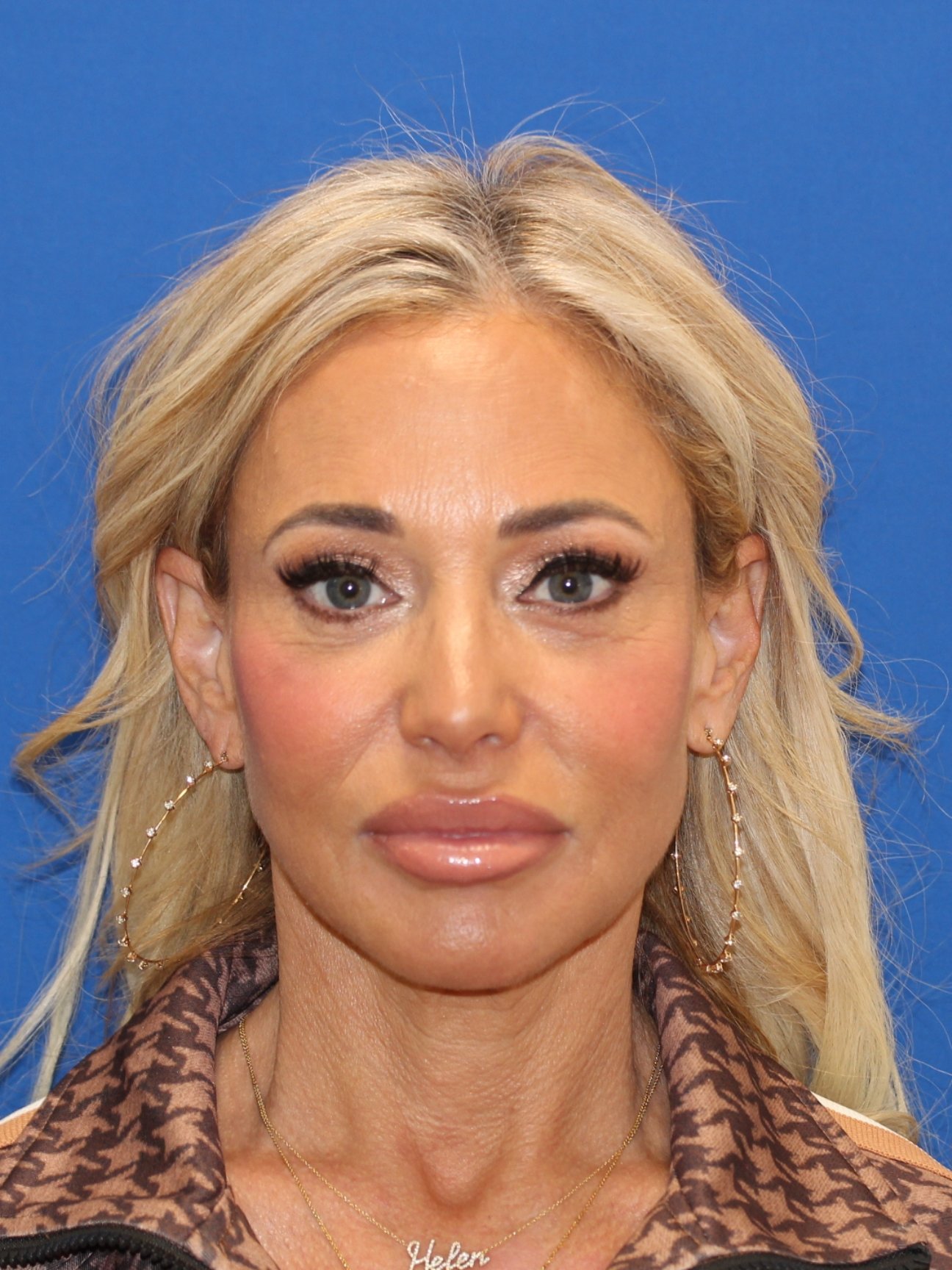

Skin quality completes the picture. Surgery restores shape but cannot rebuild skin, so I pair surgical care with a long-term skincare routine to help preserve results as aging continues.
How to Choose the Best Facial Plastic Surgeon for Natural Results
The best facial plastic surgeon for natural results is one who evaluates your whole face rather than the single feature that brought you in. When comparing surgeons, I recommend looking for:
- Board certification in facial plastic surgery: The American Board of Facial Plastic and Reconstructive Surgery certifies surgeons who have completed specialized training focused on the face, head, and neck.
- A practice focused on the face: Surgeons who concentrate on facial plastic surgery see facial aging patterns every day and refine their approach over thousands of cases.
- A whole-face consultation: A thoughtful surgeon explains how your concern relates to the rest of your face and discusses the order in which procedures should be done.
- Consistent before-and-after photos: Results should look like a younger version of each patient, not a different person.
- Honest guidance on timing: Sometimes the right answer is to wait, prepare the skin, or choose a more comprehensive plan.
These are the standards I hold my own practice to. As a facial plastic surgeon in San Diego, I am double board-certified by the American Board of Facial Plastic and Reconstructive Surgery and the American Board of Otolaryngology–Head and Neck Surgery. For more than two decades, my practice has been limited exclusively to the face.
Patients travel from across the country and around the world to see me at my accredited surgical center in Carmel Valley. If you are considering a neck lift, eyelid surgery, or any other facial plastic surgery and want to understand what will look natural for your face, request a consultation with me, a facial plastic surgeon in San Diego, who will evaluate your face as a whole.
Disclaimer: This information is provided for educational purposes only and does not replace a consultation with a board-certified facial plastic surgeon. Outcomes, risks, and suitability vary from patient to patient.
Sources
- Wan D, Amirlak B, Rohrich R, Davis K. The Clinical Importance of the Fat Compartments in Midfacial Aging. Plastic and Reconstructive Surgery Global Open.
- StatPearls. Anatomy, Skin, Superficial Musculoaponeurotic System (SMAS) Fascia. National Library of Medicine.
- Complications of Blepharoplasty. Orbit, 2006;25(4):303-18.
- American Board of Facial Plastic and Reconstructive Surgery
- Karam AM, co-editor. Rejuvenation of the Aging Face.